
Fabrication in Offshore and Marine Industries: A Complete Guide to Welding, Inspection, Quality Control, and Structural Integrity
Introduction
Offshore and marine structures are under harsh conditions where corrosion, wave loading, vibration, fatigue, and changes in temperature and constant mechanical stress may influence equipment and structural parts. The standard to which these parts are produced, assembled, welded, and inspected is of significance to the long-term performance.
Transformation of engineering drawings, raw materials and specifications into functional components or structures is referred to as industrial fabrication. In offshore and marine applications, the process should be carefully planned, as a minor error in the dimension, weld discontinuity, or a material problem could impact the functioning of a vital structure.
Starting with offshore fabrication and marine fabrication through welding, inspection, and quality assurance, each of these phases plays a role in the overall condition and maintenance of the final product.
What Is Offshore and Marine Fabrication?
Offshore and marine fabrication can be defined as the production and assembly of parts that are utilized in ships, offshore platforms, marine facilities, lifting systems, pipelines, structural frameworks, and other industrial machinery.
The work can be in the form of structural steel, stainless steel, aluminium, specialty alloys, and other engineering materials chosen based on the environment of operation. Common operations are cutting, forming, machining, fitting, welding, assembly, dimensional check, surface preparation, and inspection.
Approved material specifications and engineering drawings are usually the starting point of the process. Fabricators will then undergo a set of procedures to create components that meet a set of dimensional and quality requirements.
Key Stages of the Fabrication Process
Material Selection and Preparation
The choice of materials varies according to the strength requirements, the operating conditions, the exposure to corrosion, temperature, load requirements, and specifications used. Before production, the materials should be identified and inspected appropriately.
Cutting and preparation should also be able to attain the necessary dimensions and edge conditions. Appropriate preparation will provide a proper base upon which further preparation of fitting and welding will occur.
Welding and Fabrication
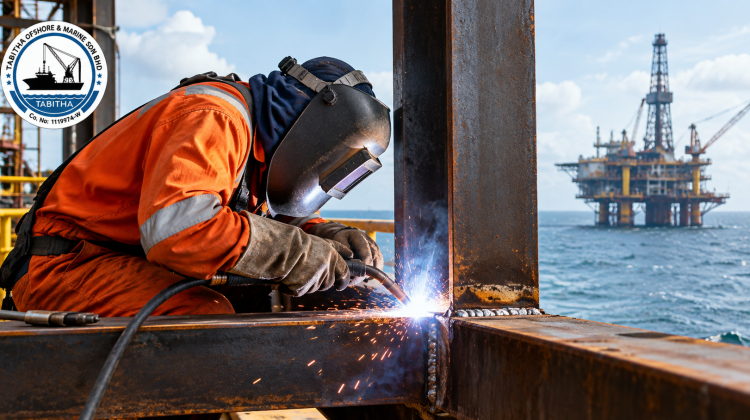
The processes of Welding and Fabrication are closely related in the construction of offshore and marine. Welding is used to assemble pre-cut parts and manage the variables of the joint configuration, heat input, sequence, consumables, and distortion.
Proper welding processes and skilled workers are significant in the manufacture of uniform joints. Preheating, interpass temperature control, post-weld treatment, and visual examination might also be necessary based on the material and the type of use.
Assembly and Dimensional Control
Once the individual components are made, they are fitted and assembled based on the engineering drawings. Alignment of dimensional verification checks, angles, tolerances, hole locations, and the general geometry.
Correct assembly can avoid installation problems and minimize the chances of undue stress due to misalignment.
Why Fabrication Inspection Matters
Fabrication Inspection is an external means of determining whether the work done is satisfactory to the requirements. Checking may occur at various levels instead of being done when the final structure is completed.
Surface damage, inappropriate dimensions, weld anomalies, poor fit-up, or other surface anomalies may be noticed through visual inspection. Non-Destructive Testing (NDT) can be conducted using ultrasonic testing, magnetic particle inspection, or dye penetrant testing depending on the application and requirements of the test.
The inspection records are also helpful in documenting quality control, maintenance planning, and future assessment.
Quality Control in Offshore Projects
Quality control starts prior to production and extends into the project lifecycle. The systematic quality program may involve the traceability of the materials, accepted procedures, welding records, inspection plans, dimensional checks, NDT records, and final documentation.
Inspection and testing must be according to the project, component, material, and industry standards requirements. There are clear acceptance criteria which assist the inspection teams to decide whether the observed conditions need correction, re-examination, or acceptance.
Good documentation is also crucial since it leaves a traceable record of what has been manufactured, inspected, tested, and approved.
Supporting Structural Integrity
Structural Integrity is aimed at ensuring that a structure or part can accomplish its purpose during its service life.
The structural integrity in marine and offshore environments may be affected by corrosion, cyclic loading, fatigue, the quality of welds, the degradation of materials, accidental damage, and environmental exposure. Adequate manufacturing and inspection processes can be used to determine possible areas of weakness before they become larger issues.
In the case of existing assets, periodic inspection may also be used with condition monitoring and NDT to determine the state of key components and assist in making maintenance decisions.
Common Applications
The applications of offshore and marine fabrication work can cover numerous applications such as structural frames, access platforms, equipment supports, pipe supports, vessel components, lifting-related structures, skids, brackets, handrails, and other engineered assemblies.
The actual production and inspection needs depend on the functionality of the component, material, loading conditions, operating environment, and project specifications used.
Best Practices for Better Quality
Engineering, production, welding, inspection, and quality team coordination are critical to the successful project. Before work commences, there should be clear drawings and specifications, and materials and consumables should be controlled accordingly.
Atomistic points should be inspected to ensure that faults or misalignment are detected at an early stage when they can be rectified without incurring hardships or high costs. Adequate documentation, quality personnel, calibrated inspection equipment, and appropriate NDT techniques further contribute to the consistency of quality.
Risk-based approach can also be used to prioritize key components and inspection processes based on the importance of their operation and the impact of failure in the event of failure.
FAQs
Q1. What is fabrication in the offshore industry?
Ans: It refers to the process of producing, fabricating, and assembling structural and mechanical parts to be used offshore through controlled engineering, welding, inspection, and quality control.
Q2. What is the difference between offshore and marine fabrication?
Ans: Offshore work tends to deal with offshore structures and equipment, whereas marine fabrication tends to deal with vessels, marine infrastructure, and equipment working in marine settings. There can be significant overlap between the two.
Q3. Why is welding important in offshore structures?
Ans: Welding is used to make structural and mechanical parts work together permanently. Qualified personnel, proper welding procedures, inspection, and quality control can assist in making sure that joints are in compliance with the needed performance standards.
Q4. What are the NDT techniques that are applied in the inspection of fabrication?
Ans: The inspection programs can be based on visual testing, ultrasonic testing, magnetic particle inspection, dye penetrant testing, or radiographic testing, depending on the type of material and defects.
Q5. In what way does quality control aid structural integrity?
Ans: Quality control is used to check materials, dimensions, welding, inspection results, and documentation against the specifications. This mitigates the chances of unnoticed manufacturing problems on service performance.
Related Services
Conclusion
The manufacturing of offshore and marine structures, capable of withstanding the rigorous work environment, involves high-quality fabrication. Starting with material Preparation, Welding and Fabrication, Dimensional check, Fabrication Inspection, NDT, and documentation, all these steps are part of the ultimate quality of an engineered asset.
With a combination of production controls and proper inspection and quality control, organisations gain better monitoring of the condition of components and help to support long-term Structural Integrity. In the case of offshore and marine, a formal system of manufacturing and inspection can offer a viable base of safer, more traceable and technically controlled processes.